
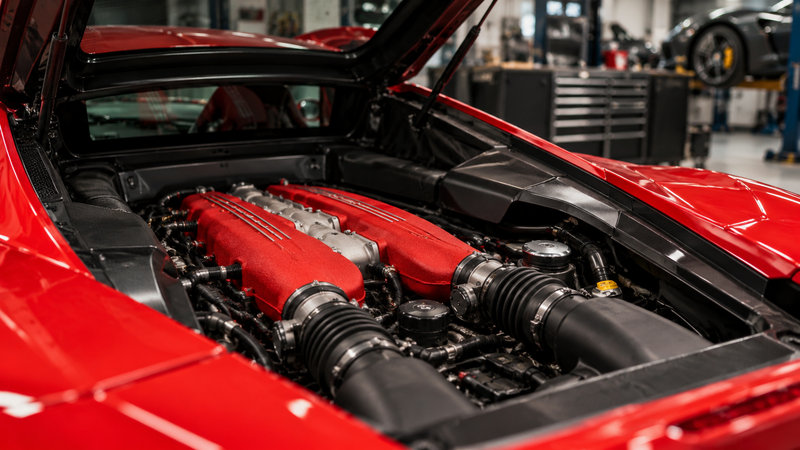
Open the engine bay of a Ferrari, and you can tell right away you’re looking at something special. Every part in there was built to spin faster, run hotter, and work harder than anything under the hood of a typical sedan.
That’s a big part of why you love driving it. It’s also why something as ordinary as an oil change works differently on your Ferrari. The type of oil, the schedule, and even the way a technician tightens the drain plug all need to match how the engine was designed. Once you know why, it gets much easier to tell good service from the kind that cuts corners.
What Your Engine Asks of Its Oil
Oil has two big jobs in any engine: It keeps metal parts from grinding against each other, and it carries heat away from the hottest spots. In a Ferrari, both jobs are a lot more complex than in a commuter.
Most everyday engines spend their lives at a relaxed pace, turning somewhere around 2,000 revolutions per minute (RPM) on the highway. Many Ferrari engines are built to rev past 8,000 RPM. At those speeds, the parts that open and close the engine’s valves move incredibly fast. The oil has to reach them almost instantly and keep them coated the whole time.
Ferrari engines also have very small gaps between moving parts, like the pistons and the cylinder walls they slide against. Engineers call these gaps “tolerances.” On a Ferrari, some of them are thinner than a sheet of paper, and a thin film of oil is the only thing filling that space.
When that film holds up, the engine feels smooth and strong. But when heat thins it out too much, metal starts to rub against metal. That’s the kind of wear you never want inside an engine this precise.
Many Ferraris Keep Their Oil in a Separate Tank
In most cars, oil sits in a pan at the bottom of the engine. Plenty of Ferrari models use a different setup called a dry-sump system. It stores the oil in its own tank and pumps it through the engine under pressure.
This design keeps oil flowing during hard cornering, when oil in a regular pan can slosh away from where it’s needed. It also lets the engine sit lower in the car, which helps with handling.
For you, the important part is that checking and filling the oil on a dry-sump car follows its own procedure. The engine often needs to be warmed up and running, and the steps vary by model. Get the steps wrong, and the car can end up with too much or too little oil, even right after a fresh change.
Why the Right Oil Is Crucial
Ferrari calls for full synthetic oil in a specific grade for each engine. That grade describes the oil’s viscosity, which is simply a measure of how thick it is. You’ll see it on the bottle as a code, like 5W-40.
Oil gets thinner as it heats up, the same way honey runs faster when it’s warm. The oil Ferrari specifies is made to stay thick enough to protect the engine even when it’s very hot and every part is moving at full speed. A generic oil, even a good one, may thin out more under those conditions.
Heat also wears oil down chemically over time. As it breaks down, oil loses some of its ability to coat parts and carry heat away. That loss hits right when a hard-working engine needs protection most.
The wrong grade usually won’t cause a problem you can hear on the drive home. The damage is slow and quiet. Parts that depend on that thin film wear a little faster with every drive. On a Ferrari, those parts are expensive to replace.
The Calendar Matters as Much as the Odometer
Lots of Ferraris don’t see many miles in a year. Some only come out on sunny weekends or for car shows. It’s easy to assume low miles means the oil is still fresh, but oil ages whether you drive the car or not.
Every time you start your Ferrari, the engine heats up, then cools back down after you park. Each of those heat cycles adds a little more wear to the oil. Short drives create another problem. When the engine doesn’t get fully warm, moisture from the air can collect inside and mix with the oil. Over a few months, that moisture and the oil’s natural breakdown start to add up.
That’s why Ferrari service schedules usually set a time limit alongside the mileage limit. For many models, that means changing the oil at least once a year, even when the car barely moved. Your owner’s manual lists the exact interval for your model, so keep it handy and follow it closely.
What a Proper Ferrari Oil Service Includes
On paper, an oil change sounds simple. Drain the old oil, swap the filter, and add fresh oil. On a Ferrari, each of those steps calls for a little more care.
Many of the parts around the drain plug and oil filter are made of aluminum. It’s lighter than steel, but it’s also softer. Each bolt has a set tightness, measured with a tool called a torque wrench. Too loose, and it can leak. Too tight, and it can crack or strip the aluminum, which turns a simple service into a costly repair.
A technician who knows Ferrari engines also uses the oil change as a chance to catch problems early. A thorough service usually includes:
- A close look at the old oil: Its color, smell, and any tiny metal flecks can point to wear or contamination long before you’d notice anything from the driver’s seat.
- A check of seals and gaskets: Small seeps around the filter housing are much easier and cheaper to fix before they become real leaks.
- Bolts tightened to spec: The drain plug and filter housing get tightened to the exact number Ferrari lists, not by feel.
- A correct oil level: On dry-sump cars, the technician follows the check procedure written for your specific model.
Each of these steps only adds a few minutes. Together, they give you a clear picture of how healthy your engine really is.
The Hidden Cost of a Generic Service
Almost any shop can drain the oil out of a Ferrari. The difference is in the details. A shop that rarely sees exotic cars may not stock the right oil, know the torque numbers, or know how to check a dry sump.
You’ll almost never notice the results of these problems on the same day as the service. Instead, you might notice a slow leak a few weeks later, a new sound at high RPM, or wear that a specialist would have caught at the last visit. That’s why, when you’re ready for an exotic car oil change in Salt Lake City, it’s vital to go with an expert shop.
Your service records also play a part. Buyers shopping for a used Ferrari often ask for a full history, and a clean record of on-time service with the correct oil gives them confidence. That can make all the difference when it’s time to sell your car.
Keep any warranty in mind as well. When your car is still under a factory or extended warranty, read the terms closely. Many plans ask for records showing the recommended service schedule was followed.
Small Habits Keep a Big Engine Healthy
Your Ferrari was built to deliver a feeling very few cars can match. Precision isn’t optional. It’s the standard every Ferrari deserves, and that includes the oil change.
At Makes & Models, we service every Ferrari with the same care that went into building it. Our team uses factory-level diagnostics, follows Ferrari’s specs down to the torque on each bolt, and walks you through exactly what we found. Searching for Ferrari maintenance near you in Utah? We’d love to meet your car.