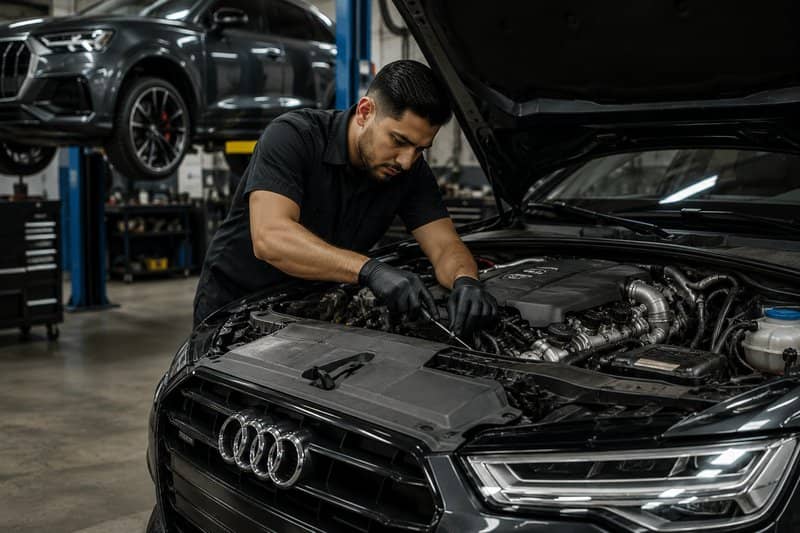
Audi builds some of the most technically sophisticated vehicles on the road. The engineering that makes an RS 5 or Q8 feel the way it does comes from tightly integrated technology across the entire platform. That integration doesn’t disappear when the car needs service. It becomes the defining challenge.
When you look at Audi car repair shops near you, one thing is crucial to understand: the shop you choose affects more than your next repair bill. It shapes how the car performs going forward, how long that performance holds, and what the vehicle is worth when you eventually sell it. Understanding why Audi service is different is the first step toward making a better choice.
What Makes Audi Vehicles More Complex to Service
Audi’s engineering is complex in ways that aren’t always visible at first glance. Quattro all-wheel drive extends well beyond mechanical hardware. Depending on the model and generation, it integrates torque vectoring logic, electronic differentials, and continuous input from the vehicle’s stability management system.
A drivetrain service on a Quattro vehicle involves understanding how those systems interact under load, not just the physical components sitting underneath the car.
Driver-assistance technology introduces another layer. Lane-keeping, adaptive cruise, and collision avoidance are part of what Audi calls its advanced driver-assistance system (ADAS) package. All of it depends on sensors, cameras, and radar units calibrated to precise tolerances.
In other words, a wheel alignment that’s slightly off or a camera bracket disturbed during body repair can reduce the accuracy of those systems in ways that don’t always produce an obvious warning. The systems may still appear to function, but their response time and precision can drift without triggering a fault light.
Then there’s the vehicle network that connects Audi’s electronic control units. Systems that seem unrelated often share data and influence each other’s behavior. A fault in one module can surface as a symptom in another, and tracing that correctly requires intimate familiarity with how Audi’s platform is structured. For a technician without regular experience on these vehicles, that diagnostic path takes longer and produces less reliable results.
Where Generic Repair Shops Fall Short
Most independent repair shops are set up to handle a broad range of vehicles efficiently. That breadth is an asset in many situations, but it becomes a limitation when the vehicle requires manufacturer-level diagnostic tools and platform-specific training.
Audi uses ODIS (Offboard Diagnostic Information System), its proprietary diagnostic platform, for full-system access. A universal OBD-II scanner will pull fault codes, but it doesn’t reach the depth of data that ODIS provides, and it doesn’t support the guided functions needed for recalibration, adaptation resets, or software updates.
That means in a general shop without the right tools, a technician is working from incomplete information from the start. And the repair plan reflects that gap.
Training follows the same principle. Audi’s technology has changed significantly over the past several model generations, and general experience with European vehicles doesn’t always translate to Audi-specific systems.
Technicians who work on Audis every day understand how these vehicles operate, recognize common failure patterns, and know how to interpret diagnostic data accurately. That expertise helps them identify the real source of a problem more quickly instead of relying on trial and error.
Without that specialized knowledge, repairs can easily miss the mark. A shop may replace parts that aren’t actually causing the issue, fix a symptom instead of the underlying problem, or overlook a related system that should have been inspected.
As a result, the original problem may return, or a new one may develop after the repair. These situations aren’t unusual. They’re often the result of using general repair methods on vehicles that require a more specialized approach.
What Audi Specialist Diagnostics Actually Require
Specialist-level Audi service starts before any physical work begins. A complete pre-service system scan establishes a baseline across all modules, not just the ones related to the scheduled work. That scan identifies stored fault codes, flags deferred maintenance items, and gives the technician a full picture of the vehicle’s condition before they lift the car.
From there, the diagnostic process draws on platform-specific tools and guided measurement functions to trace faults accurately. Live data streams from individual modules, paired with access to Audi’s repair documentation, allow a trained technician to confirm what the car actually needs instead of working from what a generic code suggests. Their definitive diagnosis means they can properly service your Audi, saving you repair time and money.
Recalibration after a repair is just as important as the repair itself. Many Audi systems, including ADAS sensors, throttle bodies, and steering angle sensors, need to be reset or recalibrated after certain services. If those steps are skipped or done incorrectly, the vehicle may not perform as intended even if the original repair was completed successfully.
Audi specialists know which systems require recalibration and make it a standard part of the repair process. Their expertise helps ensure the vehicle operates properly before it’s returned to the owner.
How Specialist Care Supports Performance and Resale Value
Consistent service from an Audi specialist pays off over time. Using fluids that meet Audi’s exact specifications, installing the proper software updates, and following the manufacturer’s recommended maintenance schedule all help keep the vehicle performing as intended.
Additionally, correctly diagnosing and repairing small problems the first time means they’re less likely to turn into larger, more expensive problems later. A vehicle maintained this way drives noticeably differently from one that hasn’t been, and that difference tends to widen with age.
The same is true when it’s time to sell. Many Audi buyers pay close attention to a vehicle’s service history, not just its appearance or mileage.
A complete record from shops with genuine platform expertise tells a specific story: this car was maintained correctly, with tools and training appropriate to the platform. That documentation gives buyers something concrete to evaluate, and buyers who understand Audis will pay for the confidence it represents.
On the other hand, a history of inconsistent or general repair work creates the opposite effect. Buyers may wonder whether the vehicle was maintained according to Audi’s standards or if previous issues were only temporarily fixed. A detailed service history from an Audi specialist provides clear documentation that the work was done correctly, reducing uncertainty for potential buyers.
Driver-assistance systems stand out in this regard. For late-model Audis with advanced ADAS packages, documented recalibration and software update history becomes an increasingly significant part of the vehicle’s value. Buyers expect those systems to work correctly, and a service record that confirms they were maintained correctly supports the asking price.
What To Look for When Choosing an Audi Specialist
When you’re searching for luxury car maintenance centers near you, proximity is less important than the specifics of how a shop actually works.
Ask whether their experience is with Audi platforms in particular, not European vehicles in general. Ask whether they run full-system pre-service scans as standard practice and whether they have access to manufacturer-level diagnostic software. A shop willing to walk you through their process usually has something worth walking through.
Pay attention to how they communicate. A specialist should be able to explain what they found and why a repair is necessary in terms that make sense to you, not just hand you a quote with line items. That transparency is part of what you’re paying for, and it’s a reliable signal that the technician actually understands the system rather than just the symptom.
At the end of the day, choosing a local shop over one that specializes in exotic vehicles hurts you in more ways than just the quality of the immediate repair. You want a shop that has the platform-specific tools and experience your car requires. You want technicians that will give your Audi the care, attention, and expertise it deserves.
Video

Infographic
Audi vehicles are engineered with interconnected systems that require platform-specific knowledge to service correctly, and the shop you choose shapes performance, reliability, and resale value long after the repair. Discover reasons your Audi needs a specialist repair shop in this infographic.