
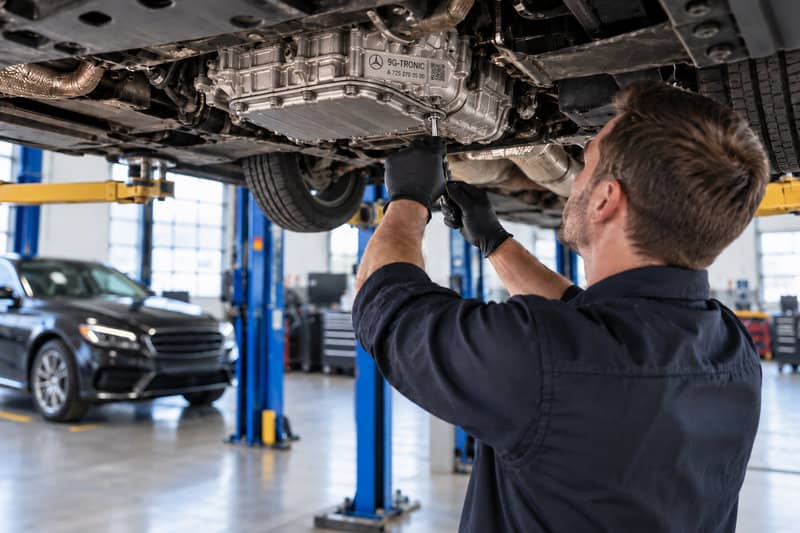
You know how a Mercedes-Benz is supposed to feel: smooth, quiet, and almost effortless when it moves from one gear to the next. When that changes, even slightly, it’s easy to blame the car’s age or assume the transmission is starting to wear out. But sometimes, what you’re feeling is the result of maintenance that was put off too long.
Transmission fluid doesn’t last forever, and the consequences of neglect can extend far beyond a rough shift. That’s why it’s vital to look for a Mercedes auto repair shop near you to keep your transmission properly serviced. Doing that can mean the difference between routine maintenance and a major repair bill.
What the 7G and 9G Transmissions Actually Need
The 7G-Tronic and 9G-Tronic are seven- and nine-speed automatic transmissions built to balance performance with efficiency. Both use adaptive shift technology, which means the transmission control module learns your driving style over time and adjusts shift points to match it. That’s part of why a Mercedes-Benz feels responsive whether you’re easing through traffic or pushing it on an open road.
Every gear change in these systems relies on transmission fluid doing three jobs at once:
- Lubricating internal components like clutch packs and gear sets
- Transferring hydraulic pressure that executes each shift
- Pulling heat away from the unit as it works
Mercedes-Benz designed these transmissions with tight tolerances between components. There’s less room for error than in a basic commuter transmission. That means there’s also less room for neglected fluid to hide. A transmission this precise depends on fluid that’s doing its job correctly.
What Happens When You Skip Fluid Changes
Transmission fluid isn’t a static substance that lasts forever once it’s added. It contains friction modifiers, detergents, and additives that break down over time. Heat is the primary reason they degrade. Every shift generates friction, and every mile in traffic or under load adds another heat cycle to fluid that’s already working hard.
Once those additives break down, the fluid can no longer lubricate or cool the way it was designed to. Old fluid runs hotter than fresh fluid. In turn, hotter fluid accelerates wear on clutch packs, solenoids, and internal seals. That wear compounds because a transmission working harder to compensate for degraded fluid generates even more heat.
Contaminants build up in aging fluid, too. Metal particles from normal wear circulate through the system instead of settling out, and they act almost like sandpaper against precision-machined components. Over enough miles, what starts as a minor fluid issue becomes a mechanical one. And mechanical issues in a transmission don’t reverse themselves.
Why Fluid Specification Is as Vital as Timing
Getting the service done on schedule only solves half the equation. The 7G-Tronic and 9G-Tronic are engineered around specific Mercedes-Benz fluid formulations. The wrong fluid can cause problems even when it’s fresh.
Generic automatic transmission fluid isn’t built with the same friction characteristics or additive package these transmissions expect. Using it can lead to a shift quality that feels slightly off, even if nothing is technically broken yet. In some cases, it can even accelerate wear rather than prevent it.
This is one of the reasons the maintenance center you choose makes all the difference. A shop that specializes in European auto repair in Salt Lake City or your area will make sure your Mercedes has the transmission fluid it needs. The right fluid at the right interval is what actually protects the transmission.
Driving Conditions That Speed Up the Timeline
Not every Mercedes-Benz wears out transmission fluid at the same rate. Stop-and-go city driving puts more strain on a transmission than steady highway miles. That’s because the constant shifting and idling generate more heat cycles per mile driven. Towing or carrying heavy loads also adds strain by forcing the transmission to work harder to maintain speed and control.
Utah’s temperature swings play a role as well. Extreme heat in the summer months accelerates fluid breakdown, while cold starts in winter put extra load on fluid that hasn’t warmed to its ideal operating range yet. If your driving includes any of these conditions regularly, your transmission fluid may need attention sooner than the standard interval suggests.
Warning Signs You’re Already Behind on Service
Most transmission failures don’t happen overnight. They announce themselves first. The trick is to know what to watch for.
- Harsh or delayed shifts: Gear changes that used to feel seamless start to feel abrupt, hesitant, or noticeably delayed, especially from a stop.
- Slipping between gears: The engine revs briefly before the transmission catches, often during acceleration or when merging onto a highway.
- Warning lights or limp mode: The transmission control module detects a fault outside its normal parameters and puts the car into “limp mode,” or restricts performance, to protect the transmission from further damage.
Any one of these symptoms is important to address right away. Together, they usually point to fluid that’s well overdue. Waiting to investigate doesn’t solve the underlying problem.
The Cost of Waiting Too Long
A transmission fluid service is a relatively small investment compared to what comes next. Once internal wear sets in, you’re no longer looking at routine maintenance. You’re looking at repair, and in the worst cases, a full transmission rebuild or replacement.
Clutch packs and solenoids don’t recover once they’ve worn down from prolonged heat exposure. Neither do internal seals once they’ve hardened or cracked under repeated thermal stress. At that point, a simple fluid change won’t fix the problem, because the damage has already moved past what fresh fluid can address. The transmission needs to come apart. That labor adds up quickly on a precision unit like the 7G-Tronic or 9G-Tronic.
Waiting also affects resale value and buyer confidence. A Mercedes-Benz with a documented service history holds its value and its reputation among informed buyers. One with a transmission failure in its past carries both a repair bill and a lingering question mark that follows the car through its next sale.
How To Stay Ahead of Transmission Problems
Mercedes-Benz publishes a recommended service interval for the 7G-Tronic and 9G-Tronic. Following it is the simplest way to protect your investment. If your car has an unclear service history, or you’re not sure when the fluid was last changed, treat that uncertainty as a reason to check sooner rather than later instead of assuming everything’s fine.
Pay attention to how your transmission feels day to day, not just when something goes wrong. Smooth, predictable shifts are the baseline your Mercedes-Benz was built to deliver. Any deviation from that baseline warrants a closer look before it becomes something bigger. A quick diagnostic check costs far less than discovering a problem after it’s already caused damage.