
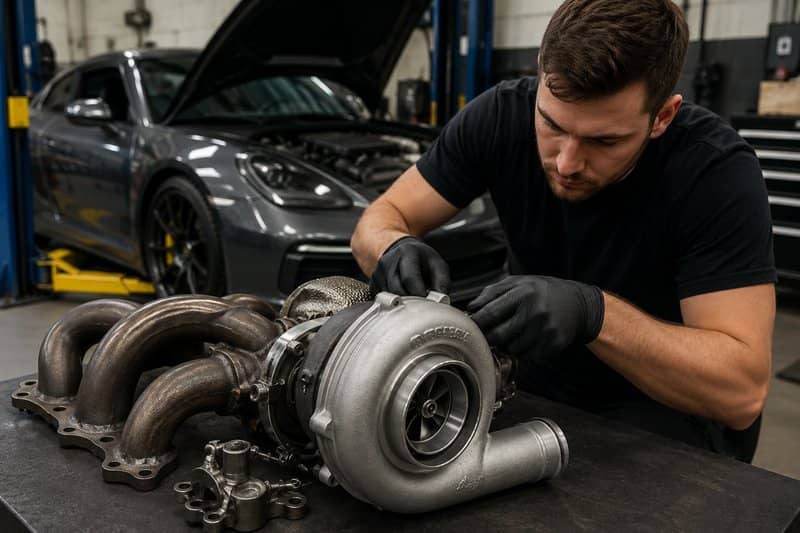
A turbo upgrade is one of the most exciting performance modifications you can make to a European or exotic car. It gives you more boost, more power, more response. It sounds straightforward, but there’s one variable that separates a satisfying upgrade from a frustrating one. It’s something most buyers don’t fully think through before they start shopping: spool time.
Understanding spool time helps you choose the right turbo for the way you actually drive. Get it wrong, and you end up with a car that feels flat below 4,000 RPM or one that’s nearly impossible to manage on the street. But get it right, and every throttle input feels exactly like it should.
What Spool Time Actually Is
Your turbocharger runs on exhaust energy. When you press the throttle, your engine produces exhaust gases, those gases spin the turbine wheel, and the compressor side of the turbo starts forcing pressurized air into your intake. Boost builds, and you feel the power.
Spool time is the delay between the moment you ask for power and the moment your turbo delivers usable boost. It’s not a design flaw. It’s a physical reality. The turbine wheel has mass, and it takes time to spin up to the speed needed to generate meaningful pressure. That gap between throttle input and boost delivery is your turbo spooling.
Every turbocharged car has some spool time. The question for any upgrade is how much you’re willing to accept, and where in the RPM range you want boost to arrive.
Why Spool Time Shapes the Driving Experience
Think about the last time you pulled out of a slow corner or tried to merge onto the freeway in a turbocharged car. The response you felt in that moment was spool time in action.
For street driving, a turbo that spools quickly at lower RPMs gives you usable power in the situations you encounter most often: accelerating from a stoplight, overtaking at highway speeds, or navigating an on-ramp. You don’t need to rev the engine into its upper range to access the boost. The car feels alive and responsive in everyday conditions.
For track driving, the calculation shifts. You’re spending more time at higher RPMs, and the burst of power at the top end matters more. A turbo that takes longer to spool but delivers significantly more peak boost can make sense for track-specific builds, where driver technique accounts for the lag and maximizes the power when it arrives.
Most street-driven exotic and European cars benefit from a turbo that prioritizes low-to-mid RPM response. That’s the range where you spend most of your time, and it’s where a well-chosen upgrade makes the car genuinely more rewarding to drive.
Turbo Size and Spool Trade-off
Turbo size is the most direct factor in spool behavior, and it’s where most upgrade conversations start. Larger turbos move more air, which means higher peak power, but they also require more exhaust energy to spin up, which increases spool time. Smaller turbos spool faster but cap out at lower boost levels.
This is the core trade-off of any turbo upgrade, and there’s no version that sidesteps it entirely. A turbo that spools at 2,000 RPM won’t produce the same peak power as one that spools at 3,500. The goal is finding the size that matches both your power targets and your driving habits.
Beyond raw size, turbine and compressor wheel design play a significant role. An extended tip or billet compressor wheel can improve flow efficiency, which sometimes allows a physically larger turbo to spool faster than an older or less refined design. Matching compressor maps and turbine housing A/R ratios to your specific engine is a precision exercise, not a rule-of-thumb selection. This is why the shop doing the work is just as important as the parts you choose.
Brands like Garrett, BorgWarner, and Precision Turbo approach design differently, and each has strong applications depending on the platform. Knowing which fits your engine, your power goals, and your intended use requires hands-on experience with the specific vehicle.
Twin-Scroll and Variable Geometry Options
Two technologies have significantly improved turbo spool time in European and exotic vehicles. Understanding how they work can help you make a more informed decision when comparing turbo upgrade options.
Twin-scroll turbos use a divided turbine housing to keep exhaust pulses from different cylinders separate. By preventing the pulses from interfering with one another, the turbo can capture exhaust energy more efficiently.
This allows the turbo to spool faster, improving low-end throttle response without reducing top-end performance. Because many modern BMW, Porsche, and Audi models already come equipped with factory twin-scroll turbos, aftermarket upgrades need to provide a clear performance advantage over the original design to justify the investment.
Variable geometry turbos (VGT) take a different approach by using adjustable vanes inside the turbine housing. At lower engine speeds, the vanes narrow to increase exhaust velocity, helping the turbo spool more quickly. As engine speed rises, the vanes open to maximize airflow and support higher power output.
This design greatly reduces the traditional trade-off between quick spool time and high-RPM performance, although the added mechanical complexity typically makes VGT systems more expensive and demanding to maintain.
How a Turbo Upgrade Affects Your Tune
A proper turbo upgrade requires more than installation. Your engine management system controls fueling, ignition timing, and boost targets based on what it knows about your turbo’s behavior. A new turbo changes those parameters, and your ECU needs to be recalibrated to match.
Running a larger turbo on a stock tune produces poor results. The ECU may limit boost to protect a turbo that no longer exists, or allow conditions that stress the new hardware. Either way, you leave power on the table and introduce risk.
A complete upgrade includes a custom ECU tune developed on a dyno after installation. The tuner maps your new boost curve, adjusts fuel and ignition to match, and verifies the setup under load.
That process is when you see the full potential of the upgrade. It’s also when any unexpected behavior, such as boost creep or rich conditions, gets identified and corrected in a controlled environment rather than on the street.
What the Upgrade Process Looks Like
The turbo upgrade process begins with a complete inspection of your vehicle’s forced induction system. An experienced technician won’t just look at the turbocharger. They’ll also evaluate the intercooler, charge pipes, wastegate, and other supporting components. Replacing the turbo while leaving worn or undersized parts in place can limit performance and increase the risk of future problems.
Once the technician has assessed the system, they’ll help you select the right turbo based on your vehicle, performance goals, and intended use. If you’re considering turbocharger replacement for luxury cars in Salt Lake City, choosing a shop with extensive experience working on European and exotic vehicles is essential.
For example, a Porsche 911 Turbo S, BMW M3, and Audi RS 7 each have different power delivery characteristics and tuning requirements. Achieving the best results requires a platform-specific approach rather than a one-size-fits-all solution.
After the new turbo is installed, the vehicle is custom tuned on a dynamometer to optimize performance. The process usually begins with baseline dyno runs before the calibration is adjusted to match the new hardware.
Depending on the vehicle, technicians may also collect real-world driving data before making final tuning refinements. This helps ensure the engine delivers smooth, reliable performance under a variety of driving conditions.
Where To Go for Upgrades
A turbo upgrade isn’t just another bolt-on modification. European and exotic vehicles use sophisticated engine management systems, model-specific calibration strategies, and tightly integrated performance components that require specialized knowledge throughout the installation and tuning process.
That means you shouldn’t just go to the local shop down the road. A general mechanic doesn’t have the technical expertise to give your luxury car the upgrades it needs. And choosing the wrong turbo, overlooking supporting modifications, or relying on a generic ECU calibration can lead to all kinds of problems, including inconsistent power delivery and premature component failure.
That’s why you should choose a shop experienced in exotic car turbo repairs and upgrades in Salt Lake City. A shop that regularly works with luxury and exotic vehicles understands how each platform responds to increased boost and how to build a package that delivers reliable performance instead of simply chasing horsepower numbers.
Additionally, choosing a shop with experience in both performance hardware and platform-specific software is equally important. Proper installation, dyno tuning, and post-installation testing ensure every component works together as intended. That helps your investment deliver the responsive, dependable performance you expect.
Choosing the Right Turbo for Your Car
Spool time is a dial, not a switch. You can move it in either direction through turbo selection, housing configuration, and tune, but the best outcome is always calibrated to your specific engine and your specific goals. A track-prepped Lamborghini Huracán and a street-driven Audi RS 6 point toward very different answers, even if both owners are chasing more power.
The right turbo upgrade doesn’t mean simply choosing the biggest turbo available. It’s about balancing spool time, power delivery, supporting hardware, and expert tuning to match the way you actually drive.
When every part of the system is engineered to work together, your European or exotic car delivers stronger, more responsive performance that feels just as refined as it is powerful.