
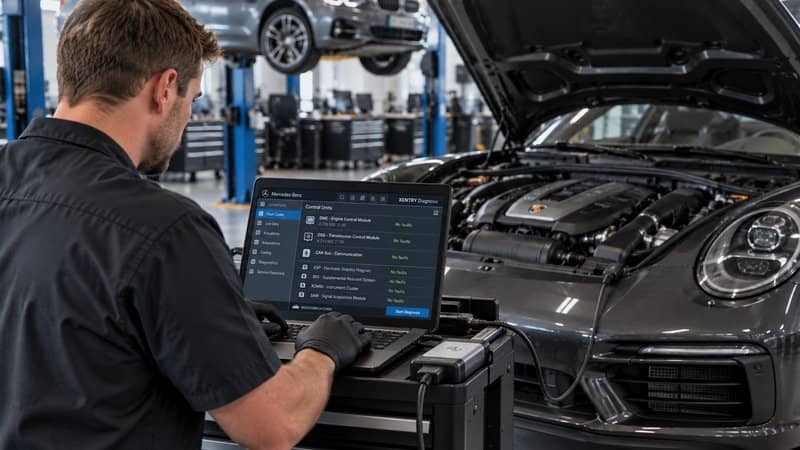
The reason a German performance car can deliver power so precisely isn’t just what’s happening under the hood mechanically. Modern Porsche, BMW, Audi, and Mercedes-Benz models rely on sophisticated computer systems. Their transmissions and communication networks work together to make thousands of decisions while you drive.
Several functions come into play, including:
- Fuel delivery
- Ignition timing
- Gear selection
- Throttle response
- Traction control
These and countless other systems have to work together with almost no delay. Three systems sit at the center of that coordination: DME, DSG, and CAN Bus. They don’t all perform the same job, but they depend on one another to produce the smooth acceleration and predictable response that define a German performance car.
That complexity is also why specialized expertise is so crucial when something goes wrong. You can’t just go to any shop for the work you need. Finding a German car service near you with the equipment and platform-specific knowledge needed is vital to diagnose these systems accurately.
DME: The Brain Behind Engine Performance
DME stands for Digital Motor Electronics, and it functions as your engine’s central computer. It manages air-fuel ratios, ignition timing, and a long list of other parameters that shift constantly as you drive.
DME doesn’t work by itself. It pulls constant input from sensors monitoring airflow, oxygen levels in the exhaust, engine temperature, and even the faint vibration signatures that indicate knock. It processes all of that data dozens of times per second and adjusts fuel and spark timing accordingly.
When you accelerate hard out of a corner or cruise at a steady highway speed, DME adjusts these settings in real time. It fine-tunes fuel delivery for efficiency at low speeds and opens things up for power when you ask for it. That balance is why a well-tuned German engine can feel both responsive and efficient depending on how you’re driving it.
DME also learns over time. It adapts to factors like altitude, fuel quality, and even your typical throttle inputs. It refines its calibration within the boundaries the manufacturer set. A DME running outdated software or compensating for a failing sensor won’t deliver that balance. Power delivery gets inconsistent, fuel economy drops, and the engine works harder than it should just to maintain normal performance.
DSG and Dual-Clutch Systems: How Faster Shifts Happen
DSG, or Direct Shift Gearbox, is Volkswagen Group’s dual-clutch transmission. It’s found across Audi’s performance lineup. BMW and Porsche use their own versions of the same core idea (DCT and PDK, respectively), each engineered around the same principle: two clutches handle alternating gears, so the next gear is already engaged before you need it.
Here’s how that plays out mechanically:
- One clutch controls the odd-numbered gears, while the other controls the even-numbered ones.
- While you’re driving in third gear, the transmission has already pre-selected fourth or second, depending on whether you’re accelerating or decelerating.
- When you shift, the system simply swaps which clutch is engaged, rather than disengaging power entirely and searching for the next gear the way a traditional automatic does.
That’s what makes dual-clutch shifts feel almost instant compared to a torque-converter automatic. There’s no pause while the transmission hunts for the next gear. It’s already there, waiting, and the transition happens in a fraction of a second.
For performance-oriented driving, that speed affects everything. Faster shifts mean less power lost between gears. That translates to quicker acceleration and a more connected feel behind the wheel. It also tends to improve fuel efficiency, since the transmission spends less time in a less-than-ideal gear and can hold higher gears longer during steady-state driving.
CAN Bus: The Communication Backbone
CAN Bus, short for Controller Area Network, is how your car’s individual systems talk to each other. Your engine, transmission, brakes, and dozens of other modules all continuously send and receive data over this network. This often happens across multiple dedicated bus lines segmented by priority and speed.
Powertrain-related messages, like throttle position and wheel speed, typically travel on a faster, higher-priority bus than comfort features like climate control or seat memory. That prioritization is essential: a delay in receiving critical data could affect how quickly the car responds to something like a sudden change in traction.
When you brake hard, the CAN Bus relays that information to the stability control system, the transmission, and the engine almost instantly. This allows them to respond together instead of independently. That coordination is what makes modern performance cars feel unified rather than like a collection of separate parts reacting on their own timelines.
CAN Bus also plays a major role in diagnostics. When something goes wrong, whether it’s a sensor reading outside normal range or a module reporting a fault, that information travels across the network and gets logged with a specific fault code. A technician with the right tools at a qualified European auto repair center in Salt Lake City can read that data directly instead of guessing at the problem based on symptoms alone.
How These Systems Work Together in Real Driving Scenarios
The clearest way to see these systems cooperate is during a hard launch or a quick downshift.
When you request a downshift by pressing the accelerator, three things happen:
- DME adjusts ignition timing and throttle response to match the new gear.
- The dual-clutch transmission executes the shift in milliseconds.
- CAN Bus carries the coordination signals between them so the engine’s rev-matching lines up with the exact moment the new gear engages.
Without that real-time communication, you’d feel a jolt or a lag between the engine and the transmission responding. But with it, the shift feels seamless, almost like the car anticipated what you wanted before you finished asking for it.
The Role of Software and Calibration
These systems rely on software just as much as they rely on physical components. The DME controls things like fuel delivery and ignition timing, while the transmission’s control unit determines when and how smoothly the gears shift. Even the CAN Bus depends on software to make sure the car’s different computers can communicate properly.
That’s why aftermarket modifications and poorly performed software updates can sometimes create unexpected problems. For example, if the DME is programmed to deliver power differently but the transmission software isn’t adjusted to match, the engine and transmission may not respond to each other the way they should.
Keeping the software for these interconnected systems properly matched is just as important as maintaining the physical components.
Why These Systems Matter for Long-Term Ownership
DME, DSG (and their BMW and Porsche counterparts), and the CAN Bus all work together rather than operating independently.
Because they’re interconnected, a problem in one system can sometimes look like a problem in another. For example, a CAN Bus communication error might trigger a transmission warning light even when the transmission itself is working properly. Likewise, a DME calibration issue can cause a dual-clutch transmission to shift poorly even when there’s nothing mechanically wrong with the gearbox.
This interconnection is why diagnosing these systems requires specialized tools designed for German vehicles. A generic code reader can tell you that something is wrong, but it may not identify which system is causing the problem or reveal that the underlying issue is coming from somewhere else.
Accurate diagnosis requires both the right equipment and the expertise to understand how these systems communicate with one another, rather than relying on a one-size-fits-all scan tool.
Keeping Your German Performance Car Running Right
Whether you’re driving a Porsche 911, a BMW M car, or a Mercedes-Benz AMG model, these systems are working together every second you’re behind the wheel. Understanding what they do makes it easier to recognize when something’s off, whether that’s a hesitant shift, an inconsistent idle, or a warning light that doesn’t quite match the symptom you’re feeling.
If you’re searching for a specialized German car service center because something feels slightly off, trust that instinct. Precision engineering deserves precision diagnostics.